
Women Watch Size Guide: What Case Size Fits Your Wrist?
A women watch size guide should help you choose a watch that looks balanced, feels comfortable and suits how you plan to wear it. Case diameter matters, but it is not the only measurement to check. Wrist circumference, lug-to-lug length, case thickness, strap width and even dial design can change how large or small a watch looks on the wrist.
For most buyers, the better approach is:
wrist size → case diameter → lug-to-lug → thickness → strap → intended style
A smaller wrist does not automatically require the smallest watch available, and a larger case is not automatically more stylish. The goal is proportion and comfort.
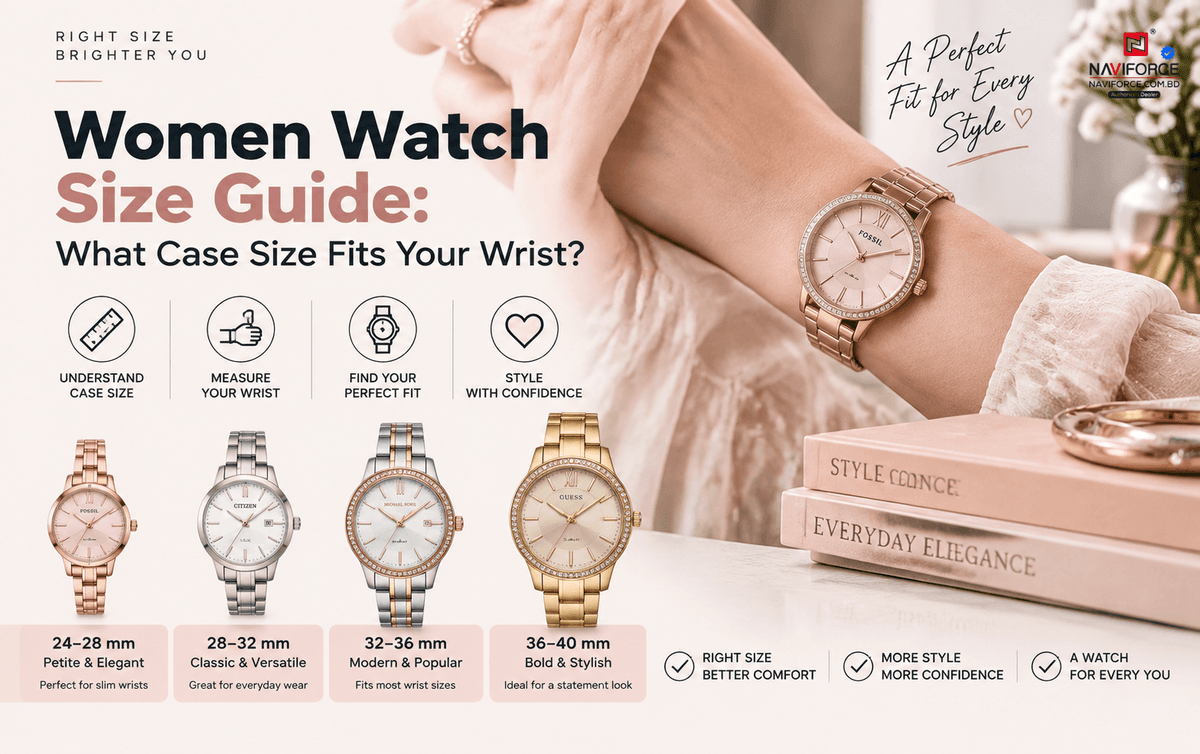
Wrist / Style Preference | Case Size Direction |
|---|---|
Very slim / delicate look | Around 22–28 mm |
Small wrist / classic style | Around 28–32 mm |
Versatile everyday look | Around 30–34 mm |
Modern / slightly stronger presence | Around 34–38 mm |
Oversized fashion look | 38 mm+ |
Smartwatch / sporty style | Often larger; fit matters more than traditional sizing |
These are starting points, not strict rules. Two watches with the same diameter can fit very differently.
What Does Watch Case Size Mean?
Watch case size usually refers to the width of the watch case, commonly measured in millimetres.
For a traditional round wristwatch, the diameter is generally measured across the case without including the crown.
For example:
- 26 mm = compact
- 30 mm = relatively small
- 34 mm = moderate
- 38 mm = stronger wrist presence
However, case diameter alone does not tell you exactly how a watch will wear.
A 34 mm watch with long lugs may look larger than another 34 mm watch with short lugs.
Why Women’s Watch Size Is Not Just About Gender
Watch sizing has changed considerably.
Women’s watches were traditionally designed much smaller than men’s watches, but current styles include:
- Small jewellery-style watches
- Classic analog watches
- Medium everyday watches
- Larger fashion watches
- Sports watches
- Smartwatches
That means “women’s size” is not one fixed measurement.
A better question is:
What size fits your wrist and your style?
How to Measure Your Wrist for a Watch
You do not need special equipment.
Use a flexible measuring tape.
If you do not have one, use:
- String
- Ribbon
- Paper strip
Wrap it around the part of your wrist where you normally wear a watch.
Do not pull it extremely tight.
Then measure the string or paper against a ruler.
Record the measurement in:
- centimetres
- or inches
This gives you your wrist circumference.
Women’s Wrist Size: Small, Medium or Large?
There is no universal classification, but this practical framework can help.
Wrist Circumference | General Fit Direction |
|---|---|
Under about 14 cm | Smaller wrist |
Around 14–16 cm | Small to medium |
Around 16–17.5 cm | Medium |
Above about 17.5 cm | Medium to larger |
Do not treat these numbers as rules.
Wrist shape also matters.
A flatter wrist may accommodate a larger watch more comfortably than a rounder wrist with the same circumference.
What Case Size Fits a Small Women’s Wrist?
For a small wrist, approximately 26–32 mm is often a useful starting range for traditional analog watches.
Smaller sizes tend to create:
- More delicate appearance
- Better proportional balance
- Easier fit under sleeves
- Less overhang
But you do not need to stay under 32 mm.
A 33–34 mm watch can still work well if:
- The lugs are short
- The watch is thin
- The dial is visually simple
- The strap fits properly
Naviforce Bangladesh currently lists women’s models around the 33–34 mm area, showing that this moderate size can work well for modern women’s watches rather than only very small cases.
What Case Size Fits a Medium Wrist?
For a medium wrist, roughly 30–36 mm offers a versatile range.
This size range can suit:
- Office wear
- Everyday use
- Formal outfits
- Casual styling
- Gifting
A 32–34 mm model often sits in a useful middle ground.
It provides better dial visibility than very small jewellery-style watches without creating an oversized look.
Can Women Wear 36 mm or 38 mm Watches?
Yes.
A 36 mm or 38 mm case can work well if you prefer:
- Larger dials
- Sportier styling
- Stronger wrist presence
- Modern fashion watches
- Easier readability
The important measurement becomes lug-to-lug length.
If the lugs extend beyond the edges of your wrist, the watch may feel too large even when the diameter itself seems acceptable.
What Is Lug-to-Lug Measurement?
Lug-to-lug measures the distance from the tip of the upper lugs to the tip of the lower lugs.
The lugs are the parts of the case where the strap or bracelet attaches.
This measurement often tells you more about fit than case diameter alone.
Why lug-to-lug matters
Imagine:
Watch A: 34 mm diameter, short lugs
Watch B: 34 mm diameter, long lugs
Watch B can occupy much more wrist space.
A useful fit principle is:
The lugs should generally sit within the width of your wrist rather than extending beyond it.
Why Case Thickness Matters
Case thickness affects comfort and appearance.
A thinner watch often works well for:
- Office wear
- Formal clothing
- Smaller wrists
- Shirts with tighter cuffs
A thicker watch creates more wrist presence.
It may suit:
- Sports styling
- Chronograph designs
- Larger fashion watches
- Smartwatches
Two watches with the same case diameter can look completely different if one is much thicker.
Does Dial Size Make a Watch Look Bigger?
Yes.
Visual size is not always the same as physical size.
A watch can appear larger when it has:
- Thin bezel
- Large open dial
- Light-coloured dial
- Minimal markers
It may appear smaller when it has:
- Thick bezel
- Dark dial
- Busy design
- Multiple sub-dials
- Smaller visible dial area
So do not choose only from the diameter written in the specifications.
Look at the proportions of the whole watch.
Small vs Medium vs Large Women’s Watches
Small Watches
Usually suit buyers who prefer:
- Jewellery-like styling
- Minimal wrist presence
- Formal outfits
- Slim cases
Typical direction:
22–30 mm
Medium Watches
Useful for:
- Everyday wear
- Office styling
- Casual outfits
- Easy readability
Typical direction:
30–35 mm
Larger Watches
Useful for:
- Bold styling
- Sports looks
- Fashion-first designs
- Larger dials
Typical direction:
35–40 mm+
Again, these are style categories rather than rigid standards.
What Watch Size Is Best for Office Wear?
For office wear, a moderate case is usually easiest to style.
A useful direction is:
28–34 mm
Look for:
- Clean dial
- Moderate thickness
- Steel bracelet or leather strap
- Neutral colour
- Comfortable fit
Very large cases can still work, but they create a more casual or fashion-led appearance.
What Watch Size Is Best for Formal Wear?
Formal watches often look better when they are:
- Smaller
- Slimmer
- Simpler
- Less visually dominant
A case around 24–32 mm can work particularly well for traditional formal styling.
However, outfit and personal preference matter more than an exact number.
A minimalist 34 mm watch can still look elegant.
What Watch Size Is Best for Everyday Wear?
Everyday watches need balance.
They should be:
- Comfortable for several hours
- Easy to read
- Easy to combine with clothing
- Not excessively heavy
For many women, 30–35 mm works well as an everyday starting range.
This range is large enough for readability but still versatile.
What About Casual and Fashion Watches?
Casual styling gives you more freedom.
You can consider:
- Larger dials
- Square cases
- Rectangular cases
- Sporty designs
- Strong colours
- Detailed dials
A 36–40 mm fashion watch may be exactly what you want even if a traditional size guide suggests something smaller.
The question is whether it sits comfortably on your wrist.
How Does Watch Shape Affect Size?
Diameter works best for round watches.
But women’s watches can also be:
- Rectangular
- Square
- Oval
- Irregular
- Jewellery-inspired
For these shapes, check:
case width + case length
A rectangular watch may have a narrow width but still occupy significant vertical wrist space.
Do not compare a rectangular 22 mm watch directly with a round 22 mm watch.
What Strap Width Looks Best on a Women’s Watch?
Strap width influences visual balance.
A smaller watch generally looks better with a narrower strap.
A larger watch can support a wider bracelet or strap.
Typical directions might include:
- Delicate watch → narrow strap
- Classic everyday watch → moderate strap
- Larger sports/fashion watch → wider strap
The strap should look proportional to the case.
Leather vs Metal: Does the Strap Change Fit?
Yes.
Leather Strap
Leather can make a watch feel:
- Lighter
- Softer
- More traditional
- Easier to adjust
It can work particularly well for smaller wrists.
Stainless-Steel Bracelet
A metal bracelet can add:
- Visual weight
- Physical weight
- Stronger wrist presence
Make sure the bracelet can be sized correctly.
Removing links may be necessary.
Silicone Strap
Silicone is common on:
- Sports watches
- Casual models
- Smartwatches
It can adapt well to different wrist sizes if the strap has enough adjustment holes.
How Tight Should a Women’s Watch Fit?
A watch should feel secure without being uncomfortable.
It should not:
- Cut into the wrist
- Leave deep pressure marks
- Slide constantly around the wrist
- Rotate under the wrist during normal movement
A practical fit usually allows a little movement but keeps the watch face close to the top of the wrist.
Should the Watch Cover the Whole Wrist?
Not usually.
For balanced traditional fit, the case and lugs should sit comfortably within the wrist width.
If the lugs visibly overhang both sides, the watch may be too large.
That said, oversized fashion styling deliberately breaks this rule.
If the watch is comfortable and you like the look, oversized sizing is a style choice rather than automatically a mistake.
Why Product Photos Can Be Misleading
Product photos are designed to show watch details.
They often use:
- Close-up photography
- Cropped framing
- Enlarged product images
- Different wrist models
As a result, a 30 mm watch can look huge on screen.
Always check the specification.
Pay attention to:
- Case diameter
- Case length
- Thickness
- Strap width
Naviforce Bangladesh’s current women’s collection contains watches across different designs and sizes, so comparing actual specifications is more useful than judging from thumbnails alone.
Women’s Watch Size for Small Wrists
If you have a particularly small wrist, prioritise:
- Short lug-to-lug length
- Smaller diameter
- Moderate thickness
- Adjustable strap
- Lightweight case
A watch can have a suitable diameter but still fit poorly if the bracelet cannot be adjusted enough.
Leather and silicone straps often provide easier micro-adjustment than some fixed-link bracelets.
Women’s Watch Size for Larger Wrists
A larger wrist gives you more flexibility.
You can consider:
- 34–40 mm cases
- Wider bracelets
- Sport watches
- Chronographs
- Larger smartwatches
Smaller watches are still possible.
A small dress watch can create an intentionally delicate contrast on a larger wrist.
Size guides should help you understand proportions—not restrict your choices.
What Size Women’s Watch Works Best as a Gift?
Gifting is harder because you may not know the recipient’s exact wrist size.
A safer approach is to choose:
- Moderate case diameter
- Adjustable strap
- Neutral styling
- Lightweight design
Around 30–34 mm can be a versatile starting direction for traditional women’s watches.
Avoid:
- Extremely small jewellery-style cases
- Very large oversized cases
- Bracelets with limited adjustment
unless you know the recipient’s preferences.
How Smartwatch Sizing Differs
Smartwatches are often larger than traditional women’s analog watches.
Their case size is influenced by:
- Display area
- Battery
- Sensors
- Controls
So a 40 mm smartwatch may not look as unusual as a 40 mm formal analog watch.
When choosing a smartwatch, focus more heavily on:
- Case length
- Wrist overhang
- Strap adjustment
- Weight
- Screen readability
Style rules are different.
Does Wrist Size Affect Watch Movement Choice?
Not directly.
Your wrist size does not determine whether you should buy:
- Quartz
- Automatic
- Digital
- Smartwatch
Movement and case size are separate decisions.
However, automatic watches can sometimes be thicker because of their mechanical construction, which may influence fit on a small wrist.
Should You Buy a Smaller Watch for a Slim Wrist?
Usually a smaller or moderate watch creates a more traditional proportional fit.
But do not automatically choose the smallest available model.
Very small dials can be harder to read.
A better balance may be:
small wrist + moderate case + short lugs + thin profile
rather than:
small wrist = smallest watch possible
Is 34 mm Too Big for a Women’s Watch?
No.
34 mm is a very versatile modern size.
It can offer:
- Good readability
- Moderate wrist presence
- Everyday versatility
- Office suitability
Naviforce Bangladesh currently lists women’s models with a 34 mm dial, which illustrates how this size can sit comfortably within mainstream women’s watch design.
Is 40 mm Too Big for Women?
Not necessarily.
A 40 mm watch can work for:
- Sports styling
- Smartwatches
- Oversized fashion looks
- Larger wrists
However, it may feel too large if:
- The lugs extend past the wrist
- The watch is very thick
- The strap cannot adjust properly
- You prefer subtle styling
Fit matters more than the number alone.
Women’s Watch Size by Style
Style | Useful Case Direction |
|---|---|
Jewellery/minimal | 22–28 mm |
Classic/formal | 26–32 mm |
Office | 28–34 mm |
Everyday | 30–35 mm |
Fashion | 32–38 mm |
Sport | 34–40 mm+ |
Smartwatch | Often 38 mm+ |
Use this table as a starting point, not a rulebook.
A Better Way to Choose Women’s Watch Size
Use this sequence.
1. Measure Your Wrist
Know your circumference first.
2. Decide the Style You Want
Do you want:
- Delicate
- Classic
- Modern
- Sporty
- Oversized
3. Check Case Diameter
Use it as the first fit filter.
4. Check Lug-to-Lug
This determines how much wrist space the watch actually occupies.
5. Check Thickness
Especially for small wrists and formal wear.
6. Check Strap Adjustment
Make sure the strap or bracelet can fit securely.
7. Compare Product Photos Last
Specifications should guide the decision before photography.
Common Women’s Watch Sizing Mistakes
Choosing Only by Case Diameter
Two 34 mm watches can fit differently.
Ignoring Lug-to-Lug
Long lugs can make a moderate case wear large.
Buying the Smallest Watch for a Small Wrist
Small is not automatically more comfortable or readable.
Choosing Only From Product Photos
Photography changes perceived size.
Ignoring Bracelet Adjustment
A beautiful watch is not useful if the bracelet remains too loose.
Assuming Women’s Watches Must Be Tiny
Modern women’s watches cover a much wider size range.
Following a Size Chart Too Strictly
A size guide is a starting point.
Your style preference still matters.
Where to Compare Women’s Watches in Bangladesh
Once you know the case-size direction that suits you, compare actual specifications such as:
- Case diameter
- Case thickness
- Strap material
- Movement
- Water resistance
- Colour
- Current availability
Naviforce Bangladesh has a dedicated Women Watches collection with current models from multiple styles and brands.
For broader watch comparisons, the main watch catalogue also includes women’s, men’s, couple and smart-watch categories.
Frequently Asked Questions About Women’s Watch Size
What is the best watch size for women?
There is no single best size. Around 28–34 mm is a versatile range for many traditional women’s watches, but wrist circumference, lug-to-lug length, thickness and personal style should guide the final choice.
What watch size is good for a small female wrist?
Around 26–32 mm is a useful starting range. A 33–34 mm watch can also work well if it has short lugs and a relatively slim profile.
Is a 34 mm watch too big for a woman?
No. A 34 mm watch is a versatile modern size that can work for office, casual and everyday wear depending on wrist proportions.
Is a 38 mm watch too large for women?
Not necessarily. It can work for larger wrists, sporty styling or an oversized fashion look. Check lug-to-lug length and thickness before deciding.
What is lug-to-lug on a watch?
Lug-to-lug is the distance from the tip of the upper lugs to the lower lugs. It helps show how much vertical wrist space a watch occupies.
How do I measure my wrist for a women’s watch?
Wrap a flexible tape around the part of your wrist where the watch will sit. Record the circumference without pulling the tape too tightly.
Should small wrists wear small watches?
Smaller cases often look balanced on small wrists, but you do not need the smallest model available. Short lugs, slim thickness and proper strap adjustment can matter just as much.
What size watch is best for office wear?
Around 28–34 mm works well for many women because it provides readability without creating an excessively large wrist presence.
What size watch is best for formal wear?
Traditional formal styling often works well with smaller, slimmer cases around 24–32 mm, although personal style can justify larger sizes.
Does strap width matter?
Yes. Narrow straps generally complement smaller cases, while larger watches can support wider straps or bracelets.
Are smartwatch sizes different from normal watches?
Yes. Smartwatches often use larger cases because they need space for a screen, sensors and battery. Fit and lug overhang matter more than traditional dress-watch sizing rules.
Final Thoughts
A useful women watch size guide should not tell every woman to wear the same case diameter.
The better approach is:
wrist circumference → case diameter → lug-to-lug → thickness → strap → style
A small wrist may look balanced with a 28–32 mm watch, but a well-designed 34 mm model can also fit comfortably.
A medium wrist can often handle 30–36 mm easily.
Larger watches can work when you want a stronger fashion or sports look.
Most importantly, do not choose from the case diameter alone.
The exact proportions determine how the watch actually feels on your wrist.
Once you know your preferred size range, use Naviforce Bangladesh’s women’s collection to compare current models by case dimensions, strap, movement and style.