
How to Choose a Wrist Watch: 7 Things to Check Before Buying
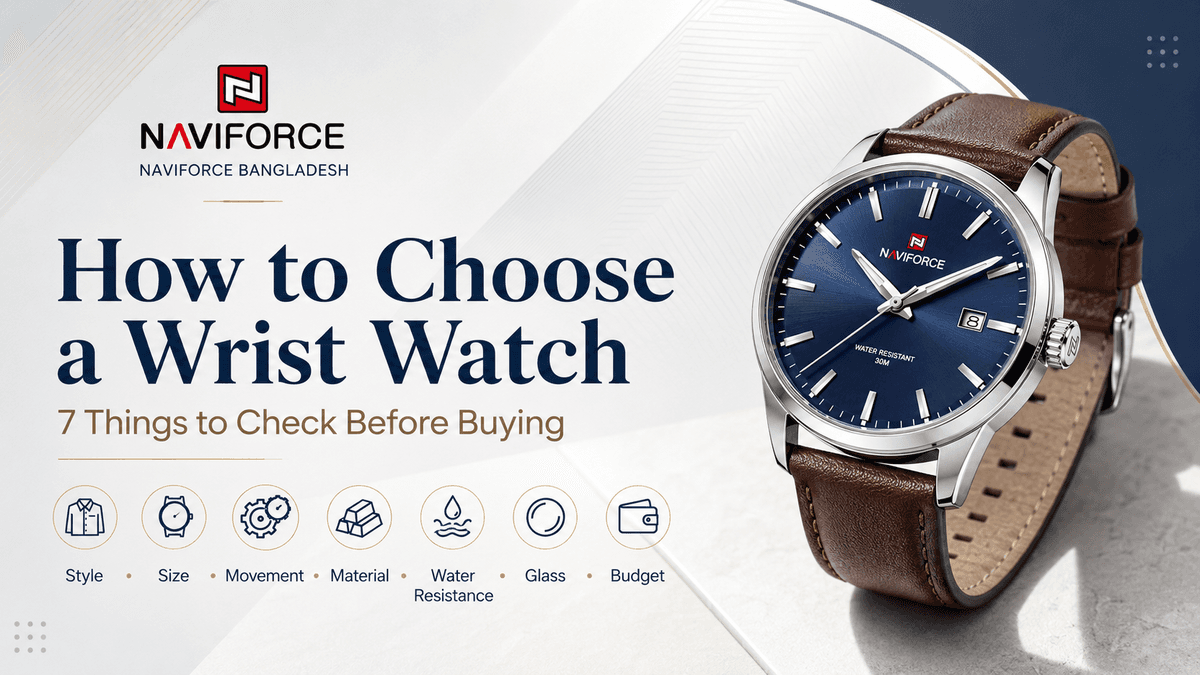
Choosing the right wrist watch becomes much easier when you focus on seven things first: movement, case size, strap, case and glass materials, water resistance, design, and the brand or seller behind the watch. Do not choose a watch only because it looks attractive in a product photo. A good watch should fit your wrist comfortably, suit how you dress, provide the functions you actually need, and match the way you plan to use it every day.
For example, someone who wants a low-maintenance office watch may be happier with a quartz model and a clean analog dial. On the other hand, a buyer interested in traditional watch mechanics may prefer an automatic model. Likewise, a large 46 mm sports-style watch can look excellent on one wrist but feel oversized on another. Timex's current sizing guidance also notes that case diameter should be considered alongside wrist circumference rather than choosing solely by appearance.
For buyers in Bangladesh, there is another practical issue: model specifications and seller reliability matter just as much as brand recognition. Naviforce Bangladesh currently lists hundreds of men's watches across different movements, case sizes, straps, styles, and functions, so buyers can compare models rather than treating every watch as essentially the same.
This guide explains exactly how to choose a wrist watch without getting lost in unnecessary specifications.
Quick Answer: What Should You Check Before Buying a Wrist Watch?
Use this checklist before you order:
What to Check | Why It Matters |
|---|---|
1. Movement | Determines how the watch is powered and maintained |
2. Case size | Determines whether the watch looks balanced on your wrist |
3. Strap or bracelet | Affects comfort, style, moisture tolerance and fit |
4. Case & crystal | Influences durability and everyday wear |
5. Water resistance | Determines how safely the watch handles water exposure |
6. Style & functions | Should match your clothing and daily requirements |
7. Brand, seller & warranty | Important for authenticity and after-sales support |
A useful rule is:
Fit and function first → style second → brand and price last.
That approach reduces the chance of buying a beautiful watch that you rarely enjoy wearing.
1. Choose the Right Wrist Watch Movement
The wrist watch movement is the mechanism responsible for keeping time and moving the hands or displays.
For most buyers, the main choices are:
- Quartz
- Automatic
- Mechanical
- Digital or analog-digital
- Solar/light-powered on selected brands
You do not need to become a watchmaker to understand the difference.
You only need to know which type best suits your routine.
Quartz Movement: Best for Easy Everyday Use
Quartz watches use an electronic system controlled by a quartz crystal.
Seiko explains that voltage applied to the quartz crystal creates a stable oscillation that can be used as a precise timekeeping reference. Quartz technology became commercially practical for wristwatches with the Seiko Quartz Astron in 1969.
In practical terms, quartz watches usually appeal to buyers who want:
- Accurate everyday timekeeping
- Low maintenance
- Easy grab-and-go use
- Broad model choice
- Accessible pricing
You may need battery replacement depending on the movement, but there is no need to keep the watch wound through regular wrist movement.
Who Should Choose Quartz?
Choose quartz if you want a watch mainly for:
- Office
- University
- Business meetings
- Everyday casual wear
- Occasional formal events
- Simple reliable timekeeping
Many current models sold by Naviforce Bangladesh use quartz movements. For example, the Naviforce 9269 combines an analog quartz movement with a 43 mm case and leather strap, while the NF9117 series uses analog quartz with casual and sports-oriented styling.
For most first-time watch buyers, quartz is the easiest starting point.
Automatic and Mechanical Watches
Mechanical watches are different.
Citizen explains that mechanical watches operate without electronic components and are powered mechanically. Automatic or self-winding versions use movement of the wrist to help wind the mainspring.
Mechanical watches appeal to people who enjoy:
- Traditional watchmaking
- Visible mechanical movement
- Sweeping hand movement
- Interaction with the watch
- Collecting watches as more than functional accessories
However, mechanical watches generally require more attention.
Seiko notes that mechanical-watch accuracy can vary with temperature, wearing time, position, magnetism, and how fully the mainspring is wound.
Therefore, do not choose automatic simply because somebody told you:
“Automatic watches are always better.”
They are different, not universally better.
Quartz vs Automatic: Which Should You Choose?
Priority | Better Starting Point |
|---|---|
Convenience | Quartz |
Accuracy | Quartz |
Minimal attention | Quartz |
Mechanical experience | Automatic |
Interest in watchmaking | Automatic |
First everyday watch | Usually quartz |
Watch collecting hobby | Either |
Your lifestyle matters more than the movement's prestige.
2. Match the Watch Size to Your Wrist
This is one of the most important—and most ignored—steps when choosing a watch online.
A 46 mm case can look normal in a close-up product image. Once it arrives, however, it may dominate a smaller wrist.
Conversely, a compact watch may look elegant on one person but too understated for someone who prefers a bold sports style.
Start With Case Diameter
Case diameter is usually measured across the watch case without including the crown.
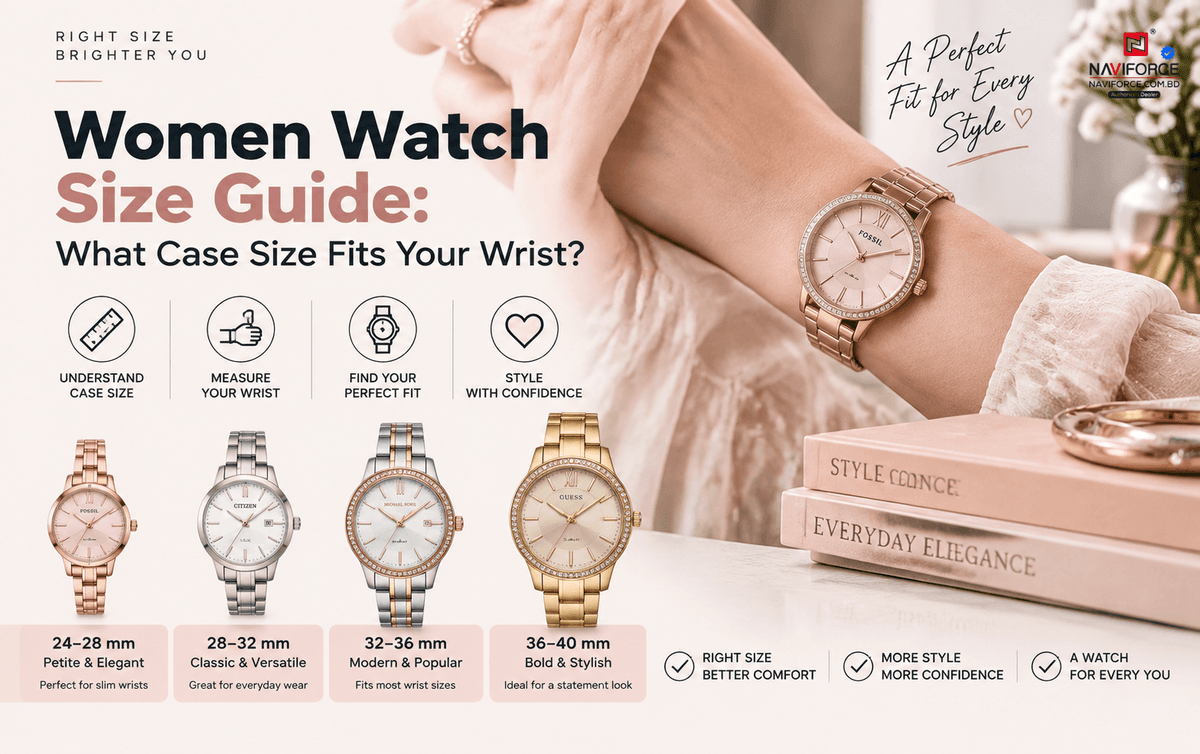
Timex currently provides this general sizing reference:
- Under 6-inch wrist: roughly 28–36 mm
- 6–7-inch wrist: roughly 36–42 mm
- Above 7-inch wrist: 42 mm and larger can work
Timex also stresses that these are style guidelines rather than rigid rules.
That last point matters.
You can absolutely wear a larger or smaller watch if you prefer the look.
How to Measure Your Wrist
Use a flexible measuring tape.
Wrap it around the wrist slightly below the wrist bone without pulling excessively tight.
If you do not have a tape:
- Wrap a piece of string around your wrist.
- Mark the overlap point.
- Measure the string with a ruler.
Then compare the measurement with the watch's:
- Case diameter
- Case thickness
- Lug length
- Band width
- Total weight
Do not use diameter alone.
Case Thickness Also Matters
A thick watch can feel much larger than its diameter suggests.
For example, a 43 mm case that is relatively slim may slide easily under a shirt cuff.
A 43 mm case with significant thickness can feel far more sporty and substantial.
Current Naviforce Bangladesh examples show this difference clearly. The Naviforce 9269 uses a 43 mm case with 13 mm thickness, while the NF9117 variants are around 45–46 mm with thicker sport-oriented profiles.
Therefore:
case diameter tells you width; thickness helps tell you presence.
3. Choose the Right Strap or Bracelet
Your strap affects comfort almost every minute you wear the watch.
The main options include:
- Leather
- Stainless steel
- Silicone or rubber
- Nylon/fabric
- PU/synthetic leather
The best choice depends on your clothing, weather, activity level, and how much maintenance you want.
Leather Strap
Leather creates a classic and often more refined appearance.
It works particularly well with:
- Formal shirts
- Suits
- Business wear
- Panjabi
- Smart-casual outfits
Brown leather usually feels more versatile and relaxed.
Black leather is usually more formal.
However, leather is less practical around heavy sweat and water than many metal or synthetic alternatives.
For Bangladesh's warm and humid conditions, buyers who sweat heavily should consider how often they will wear the watch outdoors.
Stainless-Steel Bracelet
A metal bracelet creates a stronger, more structured appearance.
It can suit:
- Office wear
- Formal clothing
- Casual wear
- Everyday use
Metal bracelets are also usually more practical around perspiration than natural leather, although they still need cleaning.
A bracelet can make the same dial appear more sporty or premium than a leather version.
Silicone or Rubber
Rubber-style straps generally make more sense when the watch is intended for:
- Exercise
- Outdoor activities
- Sport
- High-perspiration use
- Casual styling
If your priority is a formal office watch, rubber may not provide the appearance you want.
Strap Width Matters Too
A wide strap normally works better with a large case.
For example, the current Naviforce 9269 uses a 22 mm leather strap with its 43 mm case, while the NF9117-L pairs a roughly 24 mm strap with a 46 mm case.
This helps keep the watch visually balanced.
4. Check the Case and Crystal Material
A buyer may focus heavily on movement while ignoring the surfaces that receive everyday knocks and scratches.
Two specifications deserve particular attention:
case material and dial-window/crystal material.
Common Case Materials
Depending on the price segment, you may see:
- Stainless steel
- Zinc alloy
- Other metal alloys
- Resin
- Titanium in selected watches
Stainless steel is widely used because of its combination of strength, corrosion resistance, appearance, and familiarity.
However, affordable watches can also use alloy cases successfully for everyday fashion use.
The important point is transparency.
A product page should tell you what material is actually being used.
What Is the Watch Crystal?
The crystal is the transparent surface protecting the dial.
Common materials include:
- Acrylic
- Mineral glass
- Hardened mineral glass
- Hardlex-type glass
- Sapphire crystal
Each has different strengths.
Sapphire is highly scratch resistant but generally appears more often as you move into higher product categories.
Mineral glass is extremely common and offers a practical balance for daily watches.
For example, the current Naviforce 9269 listing specifies hardened mineral glass, while several older NF9117 listings describe Hardlex glass.
Do not assume every model from the same brand uses identical glass.
Always check the product specification.
5. Understand Water Resistance Before Buying
Water-resistance numbers are among the most misunderstood watch specifications.
A watch marked 30M does not necessarily mean you should swim 30 metres underwater with it.
Seiko's official water-resistance guidance states that ordinary water-resistant watches are intended for accidental everyday water contact, while 5-bar and higher ratings support progressively greater water exposure. It specifically warns that basic everyday water-resistant models should not be used for swimming.
This is why the usage guidance matters more than the number alone.
A Simple Water-Resistance Guide
Use this as a general orientation rather than overriding your watch manufacturer's instructions:
Rating | Practical Meaning |
|---|---|
Basic / 3 BAR | Everyday splashes; generally not for swimming |
5 BAR | Some swimming may be allowed depending on manufacturer |
10 BAR | Greater water activity capability |
20 BAR | More serious water exposure; still check diving classification |
Diver-rated watch | Follow specific dive-watch certification and instructions |
Seiko also warns that water resistance is not permanently guaranteed because gaskets and components age over time.
What About Naviforce 30M Watches?
Several current and older Naviforce Bangladesh models list 3ATM/30M.
For example, the NF9117 product information specifically states that its 30M resistance is not intended for swimming or hot-water showers.
Therefore, if you plan to swim regularly, do not choose a watch simply because you see “30M” in the specification.
6. Choose the Style According to Your Actual Daily Use
This is where many buyers make an emotional purchase.
They see a bold dial and think:
“That one looks best.”
Instead, ask:
“Where am I actually going to wear this?”
The answer should guide your style choice.
For Office and Business Wear
A good office wrist watch for men usually benefits from:
- Clear dial
- Moderate case size
- Black, silver, brown or neutral colour
- Leather or steel strap
- Limited visual clutter
You do not need a completely minimalist watch, but the design should work with professional clothing rather than compete with it.
A model such as the Naviforce 9269, for example, uses a 43 mm analog layout, leather strap, and business/casual positioning.
For Casual Everyday Wear
You have far more freedom.
You can consider:
- Colourful dial
- Larger case
- Chronograph
- Analog-digital display
- Sporty design
- Leather, metal or synthetic strap
The Naviforce 9208 is an example of a dual-display design combining quartz analog and LCD functionality with a leather strap.
This type of watch suits someone who wants more visual activity and functions than a simple three-hand analog design.
For Formal Events
Keep the watch relatively restrained.
Consider:
- Simple analog dial
- Leather or polished metal
- Slimmer profile
- Neutral colours
- Minimal complications
A massive sports watch can still be worn formally if you like the look, but it will make a much stronger statement.
For Outdoor or Active Use
Prioritise:
- Water resistance
- Readability
- Strap practicality
- Strong case
- Useful functions
- Secure clasp
Style should come after functionality.
Analog Wrist Watch for Men: Who Should Choose One?
An analog wrist watch for men uses hands rather than a purely numerical digital display.
Analog watches remain popular because they can work across a wide range of styles.
A simple analog watch can be formal.
A chronograph can look sporty.
An analog-digital model can combine traditional hands with additional digital functions.
Casio itself currently divides much of its watch range into analog, digital, and analog-digital formats, illustrating how display style is separate from the overall quality or intended use of the watch.
Choose Analog If You Prefer:
- Traditional watch appearance
- Business styling
- Formal versatility
- Simple time reading
- Classic dial design
Consider Analog-Digital If You Need:
- Alarm
- Dual time
- Stopwatch
- Digital date/day
- Extra everyday functionality
The right option comes down to use rather than one format being superior.
7. Check the Brand, Seller, Warranty and Authenticity
The final step is where many online buyers should spend more time.
Even a good watch becomes a poor purchase if:
- Specifications are inaccurate
- The seller cannot explain the warranty
- You receive the wrong model
- There is no replacement process
- Authenticity is unclear
Therefore, do not evaluate only the wrist watch brand.
Evaluate the retailer too.
What Should a Reliable Product Page Show?
Look for:
- Brand
- Exact model number
- Movement
- Case material
- Crystal
- Strap material
- Case diameter
- Thickness
- Water resistance
- Functions
- Warranty
- Seller contact details
If half of these specifications are missing, it becomes difficult to compare products properly.
Wrist Watch Brands in Bangladesh: Should Brand Be Your First Priority?
No.
Although buyers naturally compare wrist watch brands in Bangladesh, brand should come after fit and requirements.
A famous watch can still be wrong for you if:
- The case is uncomfortable
- You dislike its movement
- You need more water resistance
- The strap does not suit your lifestyle
- The design does not match your clothing
Likewise, a less expensive brand can provide excellent value if the specifications match what you actually want.
Naviforce Bangladesh currently sells a wide selection rather than only one watch format, including brands and product styles across quartz, analog, digital, chronograph, leather, and steel-bracelet categories. Its men's watch section currently contains hundreds of listings.
Therefore, start with the specification.
Then compare brands.
What Functions Do You Actually Need?
Modern watches can include:
- Date
- Day
- Chronograph
- Alarm
- Dual time
- World time
- Luminous hands
- Digital display
- Stopwatch
- Moon phase
- GMT
- Power reserve
More functions do not automatically mean a better watch.
If you never use a chronograph, you may prefer a cleaner dial.
If you travel often, dual time may be useful.
If you work at night, luminous hands or a backlight may matter.
Buy for Use, Not for the Specification List
A simple watch with three functions you use is often better than a complicated watch with ten functions you ignore.
How Much Should You Spend on a Wrist Watch?
There is no single correct budget.
Instead of choosing a fixed amount first, decide what level of watch you want.
Budget / Everyday
Priorities may include:
- Quartz movement
- Simple mineral glass
- Alloy or steel construction
- Basic water resistance
- Practical styling
Mid-Range
You may begin seeing:
- Better case construction
- Stronger finishing
- More refined bracelets
- Higher-grade crystal options
- Better movement selection
- Greater water resistance
Premium and Luxury
The value can increasingly involve:
- Movement engineering
- Brand heritage
- Finishing
- Materials
- Craftsmanship
- Exclusivity
- Service infrastructure
The important lesson is:
Do not buy the most expensive watch you can afford. Buy the watch that gives you the features and experience you value.
Common Mistakes When Choosing a Wrist Watch
Buying Only by Appearance
Product photography is designed to make the watch look attractive.
Always read the specification.
Choosing a Case That Is Too Large
A larger watch is not automatically more masculine or premium.
Proportion matters.
Ignoring Case Thickness
A thick watch can feel much larger than its diameter suggests.
Assuming Automatic Means Better
Automatic and quartz serve different buyers.
Misunderstanding Water Resistance
30M is not automatically a swimming rating.
Ignoring Strap Material
Leather, metal and silicone behave differently in Bangladesh's heat and humidity.
Paying for Functions You Never Use
Complications can make the dial busier without improving your experience.
Choosing Brand Before Use Case
Start with your needs.
Then shortlist brands.
Ignoring Seller Support
Warranty and authenticity matter after the purchase.
How to Choose a Wrist Watch for Men in Bangladesh
For most buyers, this simple process works:
Step 1: Decide the Main Use
Office, formal, casual, sport, or mixed?
Step 2: Choose the Movement
Quartz for convenience; automatic for mechanical interest.
Step 3: Measure Your Wrist
Do not guess from photos.
Step 4: Choose the Case Size
Make sure the diameter and thickness fit your preference.
Step 5: Choose the Strap
Leather for classic styling, metal for versatility, silicone for active use.
Step 6: Check Water Resistance
Match it to real water exposure.
Step 7: Check Materials
Review case, crystal and strap specifications.
Step 8: Check Functions
Buy only the complications you value.
Step 9: Verify the Seller
Check warranty, replacement terms and model authenticity.
Step 10: Compare the Final Shortlist
Only now should price become a major deciding factor.
A Practical Wrist Watch Buying Checklist
Before pressing “Buy Now,” ask yourself:
- Is the movement right for me?
- Is the case size suitable for my wrist?
- Will the strap be comfortable in my daily routine?
- Do I understand the crystal material?
- Is the water resistance enough for my use?
- Will I use the functions?
- Does the colour match my wardrobe?
- Is the model number clearly shown?
- Is there a warranty?
- Is the seller trustworthy?
- Can I return or replace the product if there is a problem?
If you cannot answer several of these questions, you probably need more information before buying.
Why Buy From Naviforce Bangladesh?
For Bangladesh buyers, Naviforce Bangladesh provides a broad men's-watch selection rather than forcing every buyer into one style. Its current men's category includes hundreds of models, while individual listings provide details such as movement, case dimensions, strap type, glass and water resistance.
The retailer's website also currently describes customer-support and warranty services alongside its online and retail operations.
This is useful because choosing a watch becomes much easier when you can compare:
movement → case size → strap → material → functions
within the same buying environment.
For example, a buyer may prefer a leather analog watch such as the NF9269, while another may want a larger analog-digital model such as the NF9208.
Neither is universally better.
They suit different users.
Final Answer: How Should You Choose a Wrist Watch?
The best wrist watch is not necessarily the most expensive, largest, or most complicated model.
It is the one that fits your wrist, lifestyle, clothing, and expectations.
Before buying, check these seven things:
1. Movement – quartz for convenience or automatic/mechanical for a more traditional watch experience.
2. Case size – choose proportions that suit your wrist rather than following trends blindly.
3. Strap – leather, steel, silicone, or another option should match both style and environment.
4. Materials – understand the case and crystal rather than relying only on appearance.
5. Water resistance – make sure the rating matches how you actually plan to use the watch.
6. Style and functions – buy features that support your routine.
7. Brand and seller – verify model information, authenticity, warranty, and support.
Most importantly, do not let one specification decide everything.
A quartz watch is not automatically inferior to an automatic watch. A 46 mm case is not automatically better than 40 mm. A steel bracelet is not always better than leather.
The right choice is the combination that works for you.
For buyers comparing a wrist watch for men in Bangladesh, Naviforce Bangladesh currently offers a broad range of analog, quartz, leather, steel, sport, casual, and multifunction watches that can be evaluated using the seven criteria above.
Choose for fit and use first. The right style usually becomes much easier to identify after that.
Frequently Asked Questions
1. How do I choose the right wrist watch?
Start with movement, case size, strap, materials, water resistance, style, and seller reliability. Choose according to your actual lifestyle rather than appearance alone.
2. Which wrist watch movement is best?
There is no universally best movement. Quartz is convenient, accurate, and low maintenance. Automatic and mechanical movements appeal more to people interested in traditional watchmaking. Citizen confirms that mechanical watches are powered mechanically, while Seiko explains that quartz watches use an electronic quartz oscillator for timekeeping.
3. What size watch should I buy?
Measure your wrist first. Timex currently suggests roughly 28–36 mm for wrists under 6 inches, 36–42 mm around 6–7 inches, and 42 mm or larger for many wrists above 7 inches. However, personal style can override these general guidelines.
4. Is an analog wrist watch for men good for everyday use?
Yes. Analog watches can be excellent for office, casual, and formal wear. Choose the case size, strap and functions according to your routine.
5. Is quartz or automatic better for a first watch?
Quartz is usually easier for a first everyday watch because it requires less attention and generally provides strong accuracy. Automatic watches can be more engaging for someone interested in mechanical watchmaking.
6. Is a 30M wrist watch suitable for swimming?
Do not assume so. Seiko's official guidance says basic everyday water-resistant watches are not intended for swimming, and Naviforce Bangladesh also states that selected 30M models such as the NF9117 are not for swimming or hot-water showers.
7. Which strap is best for a men's wrist watch?
Leather works well for formal and business styling, steel is highly versatile, and silicone or rubber is generally more practical for sport and high-perspiration use.
8. What should I check when comparing wrist watch brands in Bangladesh?
Compare the movement, case and crystal materials, water resistance, case dimensions, strap, warranty, authenticity, seller reputation, and after-sales support—not only the brand name.
9. Should I choose a large wrist watch for men?
Only if it suits your wrist and style. Large watches create more visual presence, but smaller and medium-sized cases can be more comfortable and versatile. Wrist proportion matters more than trends.
10. Where can I compare wrist watches in Bangladesh?
Naviforce Bangladesh currently maintains a large men's watch collection containing hundreds of models with different case sizes, movements, straps, styles, and functions, making it possible to compare specifications before choosing.